Lateral Knee Pain:
Many people will read this and wonder why this joint is so important? We never learned in anatomy or kinesiology that this joint was imporant because it has no real action or movement.
We discussed why typical treatment methods for lateral knee pain don’t work (if you missed it, click here). Now we’re going to discuss where the pain actually stems from…The Proximal Tibiofibular Joint.
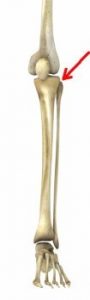 Anatomy Review

Just below the knee on the lateral side of the lower leg, lies the proximal (closest to the body’s midsection) tibiofibular joint. The is where the Tibia and Fibula meet and are held together by the tibiofibular ligament. This joint is actually designed to assist in ankle stability. This sounds like a little bit of a stretch, because it is so far away from the ankle joint. But, as you read further, it’s function as it relates to the ankle is rather important.
There are some other stuctures in the area that are very important as well. The Iliotibial Band attaches in the area of this joint. Also, several branches of the peroneal nerve are in very close proximity of the proximal tibiofibular joint. And, the Peroneal muscles originate in the area as well.
What is the Function of the Joint?
The function of the proximal Tibiofibular joint is to stabilize the ankle joint. As stated above, this may seem like a stretch because it is quite a distance from the ankle itself, but it is much more important than one might think. The ankle joint is called a mortise joint. Meaning, the talus is the tenon that is sandwhiched in between the tibia and fibula (the mortise). If one of those bones gets fractured or loses stability, there is no longer a mortise for the talus to fit into and the ankle literally falls apart.
 Usually you think of these issues as being isolated to the distal Tibiofibular joint, but it is if any part of the fibula loses stability, it will become problematic. It is actually not all that rare to see a fracture in the proximal third of the fibula when the ankle is sprained due to the stresses that are placed on the boney structures.
We discuss how these actions cause problems at the lateral knee in depth when we discuss the cause of the problem.
Looking for more help? Schedule a consultation today!
Back to Lateral Knee PainBack to Injury Rehabilitation
Back to Home


Leave a Reply