 Improving the Anaerobic capacity is the final key to improving an athlete’s movement skills as it relates to speed and power sports.
Research tells us that there are a great number of advantages to training anaerobically on a treadmill.
Payne demonstrated an increase in Oxygen uptake and lactate levels with interval uphill running. Itoh attributed similar results to a greater amount of recruitable muscle mass during uphill running, and indicated that peak lactate levels can be used as an indicator of anaerobic work capacity.
Several others have indicated that Oxygen deficit is another good indication of anaerobic power, which has also been enhanced during incline running due to the increased muscle mass (Oleson).
“Love The Lactate”
With this in mind, high speed running with varying degrees of elevation is an excellent avenue to achieving new levels of sport specific conditioning for the athlete, by introducing varying levels of lactate and hydrogen to the body.
By doing this, the body will develop an increased buffering capacity to these byproducts, which will improve the rate of movement of Lactate and Hydrogen out of muscle cell tissue via a very efficient shuttle, thereby restoring intracellular Ph and preventing fatigue (McNeely).
Athletes will find themselves possessing the ability to compete at higher levels for longer durations.
“It All Starts With The Evaluation”
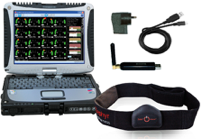
As with any good strength and conditioning workout, it all begins with a good evaluation tool. Using the Zephyr metabolic analyzer will give you everything you need to know about the athlete in a short, easy graded exercise test.
Identifying Anaerobic Threshold is the most important measure when assessing an athlete’s conditioning level. We traditionally hear a lot about VO2 Max and its important role in athletics.
The truth is, VO2 is an important tool for talent identification, but doesn’t have a large impact on daily training. This is because VO2 is rather dependant upon genetics. It can be trained to a certain degree, but at the end of the day, most athletes aren’t going to have a VO2 Max above 65 ml/kg/min. That doesn’t mean that they can’t compete at a high level of athletics when trained correctly. In fact, Lance Armstrong did not have the highest VO2 in the Tour de France, however he did have the best anaerobic fitness and lactate tolerance.
The Zephyr provides a simple and effective way of identifying anaerobic threshold. The Zephyr doesn’t use an O2/CO2 analyzer like its pricey and difficult predecessors, rather, it analyzes ventilation, heart rate and power simultaneously to allow the trainer to look and the big picture and pinpoint the anaerobic threshold.
“The Key to Metabolics: Anaerobic Thresold”
Anaerobic threshold is highly trainable and will frequently vary depending upon the athlete’s training status. The better the athlete’s anaerobic fitness, the higher the anaerobic threshold; the better the anaerobic fitness, the more intensity the athlete can tolerate for long durations.
Because the aerobic system is the most efficient of the three energy systems, it only makes sense that it is advantageous for athletes to utilize this energy system as much as possible during competition.
By pushing the Anaerobic Threshold to higher and higher limits, athletes will be able to compete at high levels of intensity while staying aerobic and not producing Lactic Acid, and thus not fatiguing.
The Zephyr will identify max heart rate, anaerobic threshold heart hate, 2 minute recovery heart rate, VO2, skin temperature, and activity level, among other things.
As discussed, the anaerobic threshold heart rate, max heart rate and the recovery heart rate are the most crucial for training speed and power athletes. Ideally, the anaerobic threshold heart rate will be very close to the max heart rate, while the recovery heart rate will be much lower than that of the anaerobic threshold.
Looking for more help? Schedule a consultation today!



Leave a Reply